
Preparing for Plastic Routing - Part 1
As companies transition from routing wood or aluminum to machining plastics, proper machine preparation can help reduce startup problems, scrap, and unnecessary finishing operations.
Factors that may be secondary when routing wood or aluminum can become critical in plastics machining. Good planning and preparation can ease the transition and reduce the costs associated with starting a new machining process.
This is the first of a two-part series. Part 1 focuses on the CNC router and its associated hardware. Part 2 addresses tooling and material selection.
Preparation of the CNC Router
Routine maintenance of CNC routers is critical to maintaining precision and repeatability in finished plastic parts.
Minor spindle vibration, gantry or bridge movement, and servo-positioning errors may have little visible impact when cutting wood, but can result in scrap or additional finishing when machining plastic.
The severity of these problems depends heavily on machine quality and adherence to the manufacturer’s recommended maintenance schedule.
Runout
The spindle, spindle mount, and collet system should be checked for TIR, or Total Indicator Runout.
Useful tools for checking runout include a dial indicator accurate to 0.001 inch or better, a magnetic indicator base, a six-inch or longer indicator stand, and a long-shank solid carbide tool, blank drill rod, or solid carbide round.
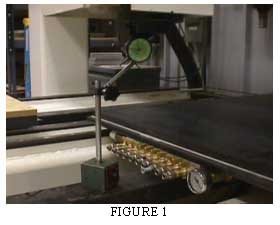
Check the Spindle Taper
The first measurement should be taken inside the spindle taper.
The spindle or router manufacturer should provide the final acceptable limit. There should be no radial play in the spindle.
Check the Collet System
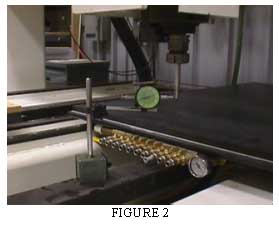
The second measurement should be taken with a rod installed in the collet. Measure runout at the point furthest from the spindle.
This measurement should be repeated several times, rechucking and rotating the rod between readings.
Because runout is additive, the result can change depending on how the taper, collet, chuck nut, and rod align. The highest reading provides the best indication of total system runout.
Check Spindle Perpendicularity
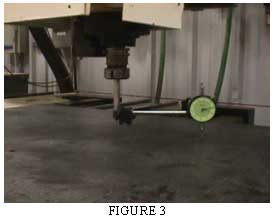
If the router performs surface milling, pocketing, or lettering where bottom finish is important, the spindle should also be checked for perpendicularity to the work surface.
This typically requires removing spoilboards and mounting a dial indicator in the spindle.
After zeroing the indicator against the main table surface, rotate the spindle 180 degrees by hand and record the Total Indicator Variance along both the X- and Y-axes.
The greater the variance, the more visible machining marks are likely to become during parallel pocketing operations. Larger-diameter cutters exaggerate this effect.
Collets
All collets and mating surfaces should be inspected and cleaned. Heavily used collets should be considered for replacement even when obvious wear is not visible.
Onsrud Cutter recommends considering collet replacement under the following conditions:
- After approximately 400–600 hours of runtime
- After a tool breaks in the shank
- After a tool spins in the collet
- After a tool has been short-shanked in the collet
- If the collet has been sprung or damaged
In wood machining, poor collet condition often first appears as reduced tool life or breakage. In plastics, it can become apparent much sooner through deteriorating edge finish.
Felt and brass brushes designed specifically for tapers and collets should be used during shift changes, manual tool changes, and whenever a collet is replaced.
Chemical cleaners can also help remove deposits that brushing does not eliminate.
Vacuum
Vacuum systems should be evaluated for their ability to hold small, thin, or lightweight plastic parts.
Improving available vacuum can reduce the need for custom fixtures while allowing higher feed rates and shorter cycle times.
Flow-Through Vacuum Systems
- Pump size: approximately 800 CFM or greater for a 4 × 8 table
- Spoilboard: lightweight, porous MDF of reasonable thickness with sealed edges to reduce leakage
- Supply lines: multiple large-diameter lines; two or more 4-inch or larger supplies per table can improve performance
Dedicated Vacuum Systems
- Pump performance: approximately 25 inHg or better under fully sealed conditions
- Spoilboard: channeled for effective vacuum distribution and sealed to reduce leaks
- Supply lines: multiple 1/2-inch diameter or larger lines are recommended
Dust Collection
Dust collection can be both too weak and too aggressive depending on the application.
Dust collection systems perform two important functions: removing chips from the machining area and helping keep the spindle and cutting tool cool.
An underpowered system can reduce spindle life and produce poor finishes by allowing hot chips to remain in the cutting path.
An overly aggressive system, particularly when combined with rigid dust brushes, can overpower vacuum fixtures used for small parts and cause movement or even part ejection.
Air Cooling
Mist and liquid coolants are generally impractical for many CNC plastic-routing applications, but air cooling can be highly effective.
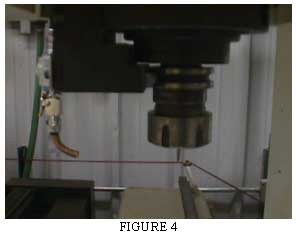
A simple air nozzle directed at the cutting tool can improve both cut quality and tool life by cooling the tool and cutting path, removing warm chips, and reducing chip wrap.
Chilled-Air Nozzles
Another option is a chilled-air device commonly referred to as a cool gun, cold gun, or Venturi gun.
These systems use a Venturi effect to reduce the temperature of the air flowing from the nozzle. The cooler air can extend cutter life and improve cut quality.
The tradeoff is reduced air velocity, which decreases the nozzle’s ability to remove chip wraps. The nozzle may therefore need to be positioned closer to the router bit, particularly when a dust collection system is also operating.
Conclusion
Evaluating machine condition before beginning a plastic-routing operation can substantially improve the likelihood of producing acceptable parts efficiently.
Spindle runout, collet condition, vacuum performance, dust collection, and cooling all have a direct effect on cutting quality and productivity.
Part 2 of this series covers tool selection and material selection before actual machining begins.