
The Importance of Spoilboards in the Machining Process
CNC routers combine high spindle speeds and high feed rates to improve productivity, but those advantages depend on keeping the workpiece rigidly secured. Spoilboard design and vacuum performance therefore play a critical role in machining quality and consistency.
Types of Spoilboards
Dedicated Spoilboards
Dedicated spoilboard systems are traditionally used to machine individual parts held by a gasketed vacuum fixture.
A simple piece of MDF or particleboard with drilled holes surrounded by self-stick weather stripping is generally not sufficient for demanding high-speed machining applications. Proper construction is necessary to maximize part hold-down and reduce vibration.
The first consideration is gasketing material. A quality closed-cell foam should be used because it can repeatedly recover its original shape after compression.
After the gasketing material is selected, a channel should be routed into the spoilboard around the perimeter of the part. Recessing the gasket helps the workpiece sit firmly against the spoilboard surface and extends gasket life.
Vacuum ports should be drilled inside the gasket perimeter. Connecting these ports with a routed groove distributes vacuum toward the outer edges of the part and increases holding force.

Double-sided melamine board can also reduce vacuum leakage compared with untreated porous board materials.
Universal Flow-Through Spoilboards
The second major approach is universal vacuum, also called high-volume, flow-through, or suck-through vacuum.
This system distributes vacuum across the entire surface of a low- or medium-density spoilboard and is commonly used when cutting parts from full sheets of material.
Universal vacuum systems reduce setup time and work particularly well for larger parts. Smaller parts can be more difficult because available vacuum holding area decreases as material is removed.
Tab cutting and skin cutting can help stabilize small parts by leaving either small connecting tabs or a thin layer of material along the bottom of the part. These connections are removed in a secondary operation.
Improving Universal Vacuum Performance
Because flow-through systems rely on high airflow rather than a sealed dedicated fixture, vacuum leakage must be controlled carefully.
- Seal spoilboard edges with rubberized paint or another suitable coating.
- Use smaller-diameter cutters when practical to reduce cutting pressure and open cutting area.
- Cover unused spoilboard areas with scrap material or plastic sheet.
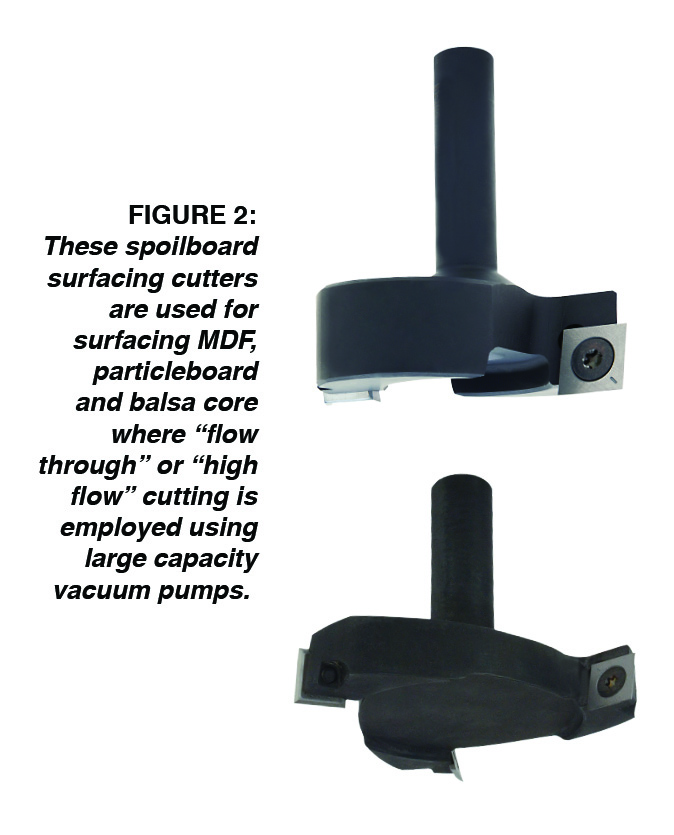
- Surface the spoilboard with a large-diameter spoilboard cutter.
- Surface both sides initially to improve porosity and establish flat, parallel surfaces.
- Resurface periodically to remove cutter grooves and maintain flatness.
Vacuum System Requirements
The vacuum system itself should also be evaluated regularly to ensure that the spoilboard can provide adequate holding force.
Flow-through systems: approximately 400 CFM at 15 inHg.
Dedicated systems: approximately 80 CFM at 25 inHg.
Supply Line Size
- Flow-through systems: 3-inch minimum supply lines, with 4- to 5-inch lines preferred.
- Dedicated systems: 3/8-inch minimum supply lines, with 1/2-inch lines preferred.
Additional Vacuum Checks
- Verify that enough vacuum sources are available.
- Minimize unnecessary bends in supply lines.
- Seal potential vacuum leaks.
- Cover unused areas of the spoilboard.
- Monitor pump performance under actual cutting conditions.
Conclusion
Regardless of the spoilboard method used, good construction and vacuum-management practices are necessary to keep parts rigid during machining.
In high-speed plastic routing, reliable part hold-down directly affects edge quality, scrap rate, cutter life, productivity, and process consistency.