
The Router Way
Router tools designed for machining mechanical plastics provide an opportunity to maximize productivity while improving chip evacuation and finished-part quality.
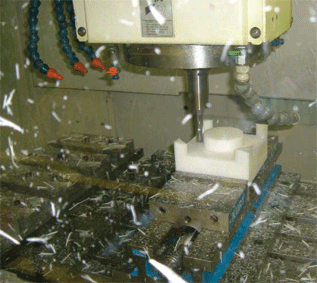
Many wear parts are made from mechanical plastics. Common examples include bearings, gears, material-handling parts, spacers, and positioning mounts where reducing vibration is important.
Traditionally, these parts have been fabricated from metal. Mechanical plastics are increasingly used because of their durability, machinability, and mechanical and electrical properties.
Common mechanical plastics include acrylonitrile butadiene styrene (ABS), Acetal, Delrin, Hydex, nylon, polycarbonate, polyurethane, and polyethylene terephthalate (PET).
Cutting Tool Geometry
Router bits for cutting mechanical plastics have traditionally been run on CNC routers at high spindle speeds and feed rates.
Testing and field experience have shown that tooling with high rake and low clearance can machine mechanical plastics productively while producing a fine surface finish.

This free-cutting geometry differs from the end mills commonly used by machine shops.
End mills are robust cutting tools designed for heavy loads, slower spindle speeds, and lower feed rates. Their limited flute area can interfere with clearing the stringy chips generated while machining mechanical plastics.
Minimal rake and clearance can also aggravate melting and rewelding. Multiple-flute end mills tend to push chips rather than carve or shear them in the manner of plastic-specific router tooling.
Tool Selection
Mechanical plastics can broadly be characterized as soft or hard by examining the chip produced during machining.
Hard plastic produces a splintered wedge and is generally machined with V-flute or other hard-plastic geometry.
Most wear plastics are made from softer plastic formulations. O-flute tools are therefore commonly recommended for mechanical-plastic machining.

O-flute tools are manufactured in straight- or spiral-flute configurations. Tool choice depends partly on the direction in which chips need to move.
Straight tools have a neutral effect. Spiral tools influence chips upward or downward.
Upcut, or right-hand, spirals are commonly used because they evacuate chips effectively. Downcut spirals can recut chips and may contribute to welding, although they remain useful when part hold-down or through-cutting requirements favor downward cutting pressure.
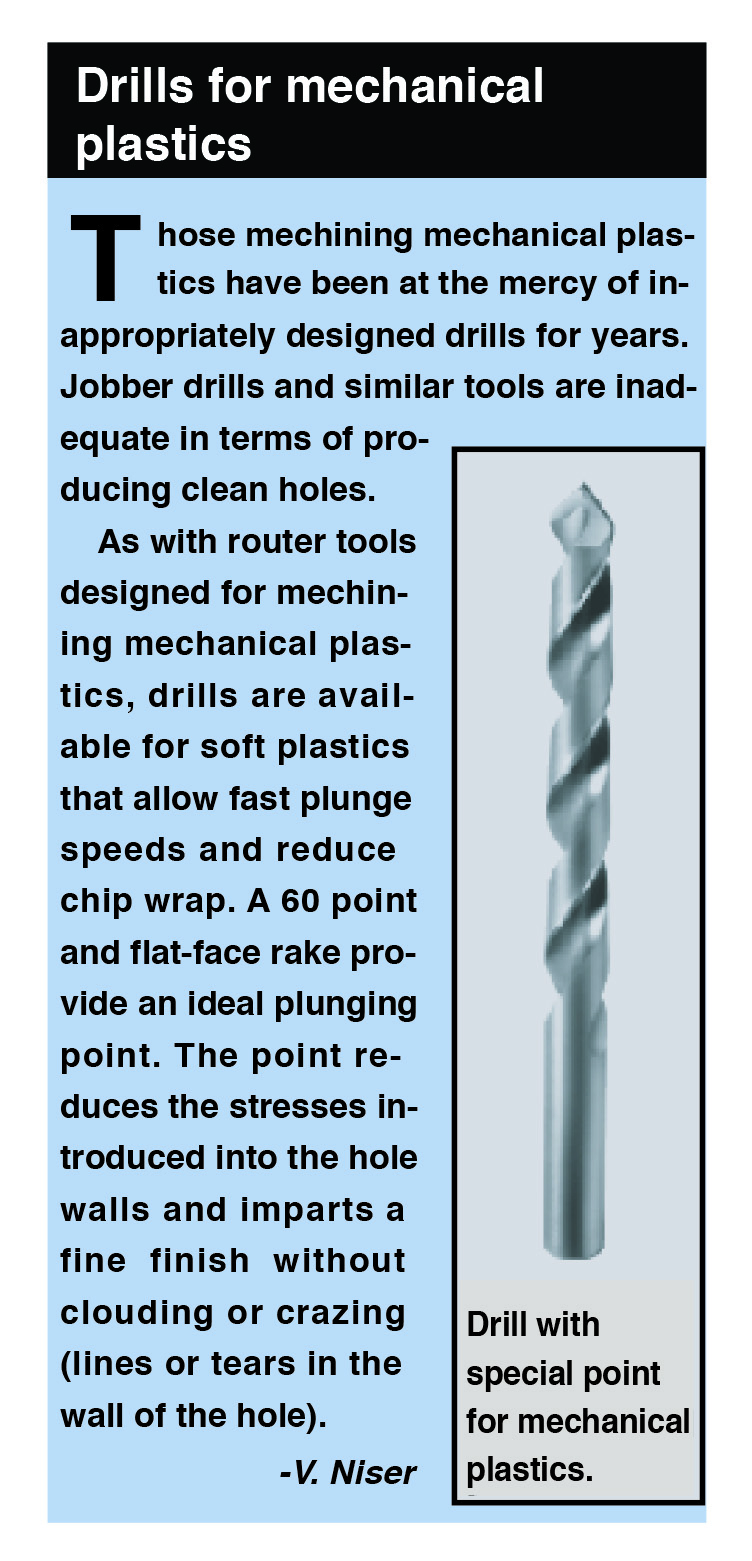
Single-edge O-flute spirals can provide a finer finish than multiple-flute end mills, and their open flute geometry improves chip evacuation when small cutter diameters are required.
If cutter balance is a concern or deeper cuts are required, double-edge O-flute spirals and three-flute finishing tools are logical alternatives.
Chip Load
Once the correct tool geometry is chosen, chip load becomes the next major consideration.
This range helps generate properly sized or curled chips. Inadequate chip load can contribute to visible knife marks and poor edge finish.
O-flute tools with high rake and low clearance can also help reduce knife marks through controlled contact with the machined surface.

Machining Methods
Modern CNC milling machines can provide the spindle speeds and feed rates required by router tooling.
Spindle speeds of 10,000 RPM and higher with feed rates exceeding 600 IPM are possible on suitable equipment. Router tools can also operate at lower spindle speeds when feed rate is adjusted proportionately to maintain proper chip load.
End mills remain common in machine shops because of availability, cost, and familiarity, but they are often applied to plastic using the same techniques used for metal.
This may involve multiple-flute tools, climb milling, roughing and finishing passes, tool changes, and coolant. These additional operations can increase cycle time and part cost.
The accuracy of CNC milling machines and rigid mechanical or pneumatic fixturing can further improve the effectiveness of router-tool geometry.
The original article reports that machine shops adopting this approach experienced increased output and reduced secondary operations such as deburring.
Conclusion
Use of mechanical plastics in machine shops continues to expand.
Matching plastic-specific router geometry with the correct chip load, feed rate, spindle speed, and fixturing can reduce cycle time while improving part quality.
Router tools designed specifically for mechanical plastics provide an alternative to machining these materials with conventional metalworking end mills.